Wednesday, October 8, 2008

Dealing with debt problems

If you're in debt and you are finding it hard to cope, it's important to deal with the problem straight away - the longer you ignore your debts, the worse the situation becomes.


Make a list of everything you owe

The first job is to sort out exactly what you owe, and to whom you owe it (your creditors). You then need to put these debts in order of importance. The most important ('priority') debts aren't necessarily the biggest ones. Priority debts are ones where serious action can be taken against you if you don't pay what you owe.

Priority debts

Priority debts are things such as mortgage repayments, rent, taxes and payments ordered by the courts: if you don't sort these out, there's a possibility you could lose your home or go to prison.

Non-priority debts

Non-priority debts include credit card payments, bank loans, catalogue repayments and money you've borrowed from family or friends. You can't ignore these, but you don't need to deal with them as a first priority.

Work out a personal budget

To find out what debt repayments you can afford, work out a weekly or monthly budget to see what you need to live on. It's important to be realistic and honest with yourself.

Your budget will show how much money you can afford to commit to paying off your debts. Your budget may also show you where you can save money.

Help with personal budgets

National Debtline provides a free self-help pack and leaflets, including help on how to work out a personal budget. You can download these from their website or ask for them to be posted to you by calling their helpline.

You can also get advice on making a personal budget.

Talking to your creditors

Once you know what you can afford, you can talk to your creditors about your situation and what you're going to do about it. Offer to pay each debt off in a way you can afford - it's important not to offer to pay more than you can afford, and not to assume you'll be able to pay more in the future.

It's important to follow up a phone call with a letter confirming what you said and agreed.

You may have little or nothing left to offer your non-priority creditors. You should still talk to them, explaining the situation; you may be able to tell them that you will pay them back at some point in the future - but don't make promises you can't keep.

Where to get help and advice

Many organisations offer free, independent advice on debt problems, so you don't need to use companies that charge.

The following organisations will give you free help and advice:

Citizens Advice Bureau (CAB)

Your local CAB is a good starting point for free advice. They provide free information and advice on legal, money and other problems: you can find your local CAB in the phone book or on their website.

National Debtline

National Debtline offers free, confidential and independent help over the phone for people in England, Scotland and Wales. You can call their helpline and also download publications from their website.

Consumer Credit Counselling Service (CCCS)

The CCCS also has a helpline, providing free, independent and impartial advice to people who have debt problems.

Your local authority

Some local authorities offer a free debt counselling service. You can check with your local authority by following the link below. You'll be asked to enter details of where you live and then taken to your local authority website where you can find out more.

Other organisations

If you're being threatened with legal action, you can check the Community Legal Advice website to see what your legal rights are. You may also be entitled to free and independent advice from your local Law Centre.

Friday, October 3, 2008

Debt Consolidation - A Guide

Debt consolidation as a means of debt management. Debt consolidation could be the way to solve your debt problems. If you are looking for a consolidation loan or have a debt or refinance problem and need some debt advice, then read our guide to debt consolidation to understand how to be better at debt management.

Who can provide debt advice if I get into financial difficulties?

If you are in financial difficulties, having built up a debt problem, perhaps by using credit cards, store cards and personal loans, and are in need of debt advice, there are a number of organizations and charities that you can turn to for guidance and help with debt management.

Before you think about taking out a debt consolidation loan you should review how you built up your debt problem, and carefully consider all the options available to you. You may, for example, be in a situation that is better addressed by approaching a debt counselling service or by getting debt advice from your existing lender(s)

Debt advice and counselling is available from several sources:

Citizens' Advice Bureaux

See phone book for local branch

www.citizensadvice.org.uk

Consumer Credit Counselling Service

0800 138 1111

www.cccs.co.uk

Community Legal Service

(England and Wales)

0845 123 2321

www.justask.org.uk

National Debtline

0808 808 4000

www.nationaldebtline.co.uk

Check out your credit rating

Use Moneyextra's Debt Consolidation tool now

Top of Page

What is debt consolidation?

Broadly speaking, debt consolidation is a debt management activity, where you take out a loan in order to pay off two or more existing debts. A variety of credit products can be used to consolidate debt including:

  • an unsecured personal loan
  • the transfer of balances to a credit card (including the use of credit card cheques to pay off non-credit card debts)
  • a secured loan or second charge mortgage (a loan secured on property, from a lender other than the existing mortgage provider, that leaves the first charge mortgage in place)
  • an advance from an existing mortgage provider secured against property but leaving the original mortgage intact
  • a remortgage

Using a debt consolidation loan to consolidate existing debt into one loan may save on your monthly outgoings while, at the same time, offering a repayment discipline and clear end-date to your debt.

Do be advised that extending the period over which you repay your debt may mean that it will cost you more overall so make sure you read the terms and conditions carefully. You should also think carefully before taking out a secured loan, securing other debts against your home. Remember, your home may be repossessed if you do not keep up repayments on a mortgage or other debts secured on it.

Use Moneyextra's Debt Consolidation tool now

Top of Page

Why might I want a debt consolidation loan?

Debt consolidation loans are a method of tackling debt problems. Many borrowers can and do benefit from consolidating their debts on better interest rate terms. You may be able to consolidate debt at a significantly lower interest rate. For example, credit card debt that could be costing you 17.9% APR (MBNA Classic, Nationwide Classic and First Direct Visa among others; source: Moneyextra Credit Cards Comparison tool - 14/02/08) could be rescheduled onto a personal loan or secured loan charging little more than a third of that rate of interest with good debt management (e.g. Sterling Credit £25,000 secured loan over 15 years, 7.6% APR; MoneybackBank £10,000 unsecured loan over five years, 6.7% APR; source: Moneyextra Loans Comparison Tool - 21/02/08) .

You may also find making one payment much more convenient than managing a number of different debt payments. In the short term a debt consolidation loan may help with cash flow by reducing your monthly outgoings, but bear in mind that this borrowing may cost more in the long term if you are paying interest for a longer period.

Opting for a debt consolidation loan with lower monthly payments can make sense as long as you understand the reasons why the payments will be lower: a more competitive interest rate, but usually an extended repayment period as well. Take a hard look at your current debt including the payments and the interest rates before you decide whether this method of debt management is for you.

Use Moneyextra's Debt Consolidation tool now

Top of Page

What does having a secured debt consolidation loan mean?

If you want to borrow sums over £25,000, your debt consolidation loan is likely to be a secured loan structured as a second mortgage on your primary residence rather than an unsecured personal loan. Many advertisements on television make it sound like debt consolidation loans will solve all your debt problems. However, the typical advertising you may see on television or in a newspaper for a debt consolidation loan will only refer to this kind of home loan refinance secured by a second mortgage.

Quite simply a secured debt consolidation loan means you are "betting the house" that you can repay your debts. Think carefully and seek advice before securing other debts against your home, because you could be putting your home at risk of being repossessed if your financial situation worsens.

Most people looking to consolidate debt are looking to consolidate unsecured debt such as overdrafts, credit cards and existing personal loans. A second mortgage represents a secured debt. This can be of critical importance because the creditor has the right to seize the collateral, your home, if the loan cannot be repaid. This means you could lose your home even if you have managed to keep up the payments on the original mortgage.

If you are going to take out a secured debt consolidation loan you must think through the potential consequences. You should also consider insurance for your debt repayments but that does not mean that you should necessarily take out the insurance being offered by the lender, you may be able to find a cheaper policy elsewhere.

Moneyextra's own figures show the average size of secured loan being searched for in January 2008 at £29,871 to be repaid over an average of 12 years 11 months.

Think carefully before securing other debts against your home. Your home may be repossessed if you do not keep up repayments on your mortgage or other debt secured on it.

Use Moneyextra's Debt Consolidation tool now

Top of Page

How do I decide if debt consolidation is right for me?

You need to start by understanding how debt consolidation fits into solving your personal debt problem. The most effective way to get out of debt is through better debt management. You can start by cutting up credit cards - stop using them altogether - then pay off any creditors gradually with the most pressing debts at the top of the list. It is important to keep making regular payments to stop your existing debt problem becoming worse by defaulting. If you do plan to take out a loan to consolidate your debt, you really do still need to think seriously about cutting up your credit cards and cancelling any overdraft facilities. This rigour will help you manage your debt.

You may have more money available each month after your debt consolidation loan is arranged but you are still in just as much debt as before. Indeed your overall debt problem may be worse if you have borrowed extra money as well. Borrowing more money to get out of a debt problem is not an option to be undertaken lightly.

You may have taken out credit cards with the intention of paying off the balance each month as well. Good intentions are fine, but unexpected things happen in life. If you are taking out a debt consolidation loan you also need to make sure your debt management strategy addresses the true cause of your debt problem.

Individuals usually get into a debt problem because they are living beyond their means and supporting their spending habits with credit cards. A debt consolidation loan may appear to solve things by paying off the existing debts. Unfortunately, if bad spending habits continue, you may find in another year or two that you have run your credit cards up to the same levels or higher than they were before the debt consolidation loan.

If in doubt about the merits of debt consolidation, seek debt advice from one of the organisations and charities offering debt counselling services.

Use Moneyextra's Debt Consolidation tool now

Top of Page

What factors should I consider before consolidating debt?

The first and most important thing you need to think about is how much you can realistically afford by way of monthly repayment. However, in addition to working out what you can afford, any borrower considering taking out a debt consolidation loan needs to know:

  • what the alternatives are. These can include re-negotiating existing payments on your debts with individual creditors
  • what the interest rate and APR is and whether it is variable
  • what the overall cost of the loan is
  • what the monthly repayments are
  • whether there are additional features which will change the rate at which the capital sum is paid back
  • what will happen if you miss a payment
  • what happens if you want to repay or refinance early
  • if the loan is secured on your home, what the consequences are of not keeping up with payments and what happens if you want to move

Use Moneyextra's Debt Consolidation tool now

Top of Page

Should I seek debt advice from a specialist in debt consolidation?

You should be wary of many firms that do nothing else but debt consolidation. They may charge high interest rates and require extra fees on top. They may claim to offer services that would reinstate your credit or rebuild your credit history. Nobody other than you can do this for yourself if you have had debt problems. Equally, nobody can wave a magic wand and improve your credit record overnight. It takes time.

Don't pay large fees to companies that claim to be able to remove information from your credit file. Don't be fooled, they can't. Only genuinely incorrect information may be removed and you can do this yourself. County Court Judgements and other information will stay on your file for six years, although they may be cancelled if the sum owing is paid within a month of the judgement.

Many companies advertising special debt consolidation loans for "restructuring" your problem debt may also offer to lend you an extra amount on top of your current debts, so you have a lump sum with which you could buy a car, or improve your home. This is not generosity on their part: the more they lend you, the more you have to pay back, and the more money they make. You should think very carefully indeed and seek debt advice before securing more debts on your home.

An investigation by the Office of Fair Trading between June 2003 and March 2004 suggested that many borrowers failed to shop around for credit for debt consolidation and that some lenders were guilty of exploiting borrowers lack of financial knowledge and debt management skills. The study also found evidence that lenders may be "inappropriately" selling expensive payment protection insurance to borrowers.

Use Moneyextra's Debt Consolidation tool now

Top of Page

26 February 2008 © Moneyextra.com

Saturday, August 30, 2008

Simple guide to debt consolidation program - frequently asked questions

What is debt consolidation program?

Debt consolidation is the most reliable way to get out of debt burden. As it involves a very simple method it is the most preferred debt solution. The process of becoming debt free through debt consolidation is known as the debt consolidation program. A debt consolidation company executes a debt consolidation program.

Why do you need to know about a debt consolidation program?

When you are burdened with debt and want to reduce your debt load, debt consolidation program will help you to overcome your debt troubles. In fact it is the best debt solution to become debt free in quicker time.

How does debt consolidation program help you?

  1. Lower your monthly payments
  2. Reduce interest rates
  3. Waive late fees
  4. Avoid bankruptcy
  5. Stop harassing collection calls
  6. Have only one monthly payment
  7. Become debt free

How does the debt consolidation program basically work?

A lot of calculations are needed to solve your debt problems and start the debt consolidation program. First, analyze the process of repayment. Knowing the debt amount is not sufficient. Knowledge about your current financial footing is also required. The amount you earn can help us to device a better plan for you. The first step towards solving debt problem is the identification of the type of loan. The amount of loan, from whom you have taken it, secured or unsecured, time limit, repayment schemes, all these things are considered before taking the first step. Overall debt consolidation program involves a few basic steps:
  1. Analyze your problem and your financial status
  2. Go through all the possible solutions and then choose the scheme which is the most suitable in your case.
  3. Make a complete plan to support your decision and go about in your repayment plans in an organized way.
  4. Be consistent with your plan. Debt consolidation is the ideal way to make you debt free. We are the leaders in this field. Fill our free membership form to learn about all the alternatives and allow us to solve your debt related problems.

In what way do the companies execute the debt consolidation program?

The entire debt consolidation program is executed in different steps. Different companies follow different methods. A better understanding of the debt consolidation program is possible if you analyze the step by step procedure of debt consolidation program in general.

An efficient debt consolidation company deals with your creditors on your behalf. They try to make the best deal for you. This way they save you a good amount on the interest charges and interest fees.

Step by step process they follow during the program:

  • Step 1:
    You register with the community forum. Throw your queries to the community, the community members will provide you with appropriate guidance to your problem. Some companies might want you to contact them and relate your trouble.

    You may have the simplest of the problem like

    debt consolidation program details
  • Step 2:
    You sign up the debt consolidation form to get free counseling from their financial expert. The Company will also give you a briefing about the fees, they charge from you.
  • Step 3:
    Now if you approve, the company hands over your problem to the consultant who will negotiate with all your creditors on your behalf. The company consultant will finally settle the deal with all your creditors when they will agree to waive off the interest rate and other charges and reduce your debt burden consequently.

    Your advantage: As your principal payable amount is reduced, your multiple debts will be merged into one and you will deal with a single company instead of multiple creditors. After eliminating the interest amount, waiving off other penalty charges, your payable amount gets reduced.
  • Step 4:
    The financial expert will provide you with proficient money management tips. He will give you guidance on budgeting and help you to gain expertise to repair your credit. The financial expert will not only instruct you with money management strategies for today but also for the future.
This way, by providing proficient debt consolidation service, the company helps you get out of debt burden. Basically they aim to create a debt free society. Their focus is to give effective support to the debtors while doing debt reduction.

How to find the best debt consolidation program?

You may find a variety of options while choosing a debt consolidation program. Do not get puzzled. Shop around and select the one that fits your needs. If you are still confused you may take up these ideas:
  1. Banks or local credit unions or banks are good options to make a fair deal.
  2. Select the banks with whom you have no deal. They will agree to make a better deal to retain you as a customer.
  3. If you get a mail from a debt consolidation program from some company, this means that the company is interested to deal with you. Try dealing with such companies.
  4. Never forget to make an internet search .Type "debt consolidation" in the search bar of any of the search engines. You will get a lot of options. But, be careful of scams.
  5. Apart from shopping around, you can get the best deal by managing your own credit. Visit some credit sites, if it needs to be worked on.
There are many who say "Get rid of your debts in 30 days", or "Re-build your poor credit in a week". These are just advertising gimmicks, for one should remember that nothing can be achieved in a short cut process. In order to get yourself debt free you should keep in mind that slow and steady wins the race. Debt relief schemes do not have the magical power to get you out of this situation in a day or a fortnight. It takes a lot of analysis of your current financial status and a plan to sustain your future.

How is the debt consolidation program better than bankruptcy?

Bankruptcy is the last option for a person undergoing debt problems. Before going for bankruptcy, get to know the nooks and corners of the process. Bankruptcy is not a true solution; rather it's just a temporary halt in your life. Debt Consolidation is not a loan; debt Consolidation Company negotiates with your creditors and reduce your debts by 40% to 60%. In some of the cases the company is able to consolidate even more. If you are signed for a debt consolidation program the creditors in most cases reduce your interest rates, eliminate late charges and over-limit charges. The account is re-aged to show that you are current with your payments.

What are the don'ts during debt consolidation program?

While doing debt consolidation program, be conscious!!! The debt consolidation program do not eliminate your debts completely rather reduces it. You will have to pay them back someday or the other.
  • Never feel that you have fewer debts. You credit card interest always escalates. Do not make major purchases while doing a debt consolidation program. It will lead you to more trouble.
  • Do not stretch your debts longer. More you delay more you will have to pay.
  • Avoid keeping your house as collateral in a debt consolidation program. You may land up being foreclosed.

Avoid Bankruptcy - Myths, Reality and Alternatives

Avoid Bankruptcy - Myths, Reality and Alternatives

In the year 2006, the total number of bankruptcy filing was 1,794,795. Bankruptcy is becoming the most convenient and easy way out for people who are facing financial troubles. However, majority of them are not aware of two very important things:
  • Bankruptcy is not a viable solution for all the people who have overwhelming debt.
  • Bankruptcy has far reaching and long term consequences that can affect adversely on an individual's life.
So, let us look at the various aspects of bankruptcy and why one should avoid bankruptcy.

Definition of bankruptcy

The term "bankruptcy" is derived from the Italian word "banca rotta", meaning broken bench. It is a federal court process designed to help consumers and businesses eliminate their debts or repay them under the protection of the bankruptcy court. However, there are specialized units for bankruptcy in each federal district court. Under the Federal Bankruptcy Act, these district courts take care of the bankruptcy filings & other functional procedures.

Types of bankruptcy

According to the Title 11 of U.S. Code, Federal Bankruptcy Code is subdivided into eight chapters. These are Chapter 1, Chapter 3, Chapter 5, Chapter 7, Chapter 9, Chapter 11, Chapter 12 and Chapter 13.

Chapter 7 and Chapter 13 are the most popular types of bankruptcy usually filed by a debtor.

Disadvantages of bankruptcy

Following are a few disadvantages of bankruptcy:
  1. Ruined credit history: Bankruptcy creates ultimate damage to one's Credit history. It remains in the Credit report for 10 years from the date it was discharged. Not only that, it also stays in Court Records for 20 years. The worst part of this is that it reduces the chances of getting loans and jobs in the future as creditors and employers judge a candidate first hand through their credit report.
  2. Property repossession: Declaring bankruptcy can result in losing valuable assets (non-exempt property) or equivalent cash value. You may need to part with your most treasured property.
  3. Stained social status: Personal bankruptcy can spoil your social status.
  4. Damaged business: Filing of bankruptcy by a business owner can shatter all chances of a growing business. The damaged credit rating due to bankruptcy will not make him qualified for business loans.
  5. Serious financial crisis: After being declared a bankrupt you can expect all your bank accounts, credit cards etc to be closed. Anything that you might be leasing, or buying on hire purchase, such as your car will be immediately returned to the owner. This can however give birth to tremendous financial crunch.
  6. Hampered aspects of life: People who have declared bankruptcy may find it extremely difficult to buy or even rent a home; acquire insurance, security clearance and buying or leasing a car. This can lead to a lot of problems & put a big question mark on the chances of having a standard & secured living. It is thus advisable to avoid bankruptcy for a safer future.

Why do people file for bankruptcy?

The following factors seem to influence bankruptcy, in general. But a combination of all these factors is however found to have greater impact on bankruptcy.
  1. Rising unemployment: Unemployment or sudden loss of job is a key factor influencing bankruptcy. In order to maintain an optimum standard of living, unemployed people are more prone to taking debt without the ability to pay back.
  2. Divorce: Rising divorce rates are seen to have influenced the number of bankruptcy filings. This is because in most cases one or both the parties suffer financially due to legal separation.
  3. Credit card usage: The more the number of cards, the more will be the amount of debt. With the increase in the number of accounts used by each adult, there is a rise in the rate of filing bankruptcy.
  4. Debt income ratio: With the rise in debt-income ratio, rate of filing bankruptcy has also increased.

Myths about bankruptcy

Bankruptcy may seem to promise a lot on the surface, but deep down it causes a lot of damages. Here is a listing of certain common misconceptions about bankruptcy:
  1. Get rid of all debts: Don't ever think that bankruptcy can help you take care of all debts. There are some debts that cannot be discharged under a bankruptcy proceeding. Most of the tax claims, alimony, child support etc. are just a few examples.
  2. Fresh start: Bankruptcy relieves the burden of debt temporarily. It doesn't offer a fresh start as bankruptcy reflects in the credit reports for the next 10 years. Creditors and dealers discard loan applications from the borrowers who have filed for bankruptcy. And even if they grant the loan, they charge high interest rates.
  3. Include only selected accounts: If you think that you have the freedom of hiding any account and not including it while filing for bankruptcy, you are absolutely wrong. The bankruptcy laws are very strict on this point and any such fraud is punishable. You can keep accounts away from bankruptcy filing only if you can pay them off fully before filing bankruptcy.
  4. Ease in filing: The process of bankruptcy is not as easy as it seems to be. It is very time consuming. Moreover with the changes in the statutory laws, it may not be that easy to file for bankruptcy.
  5. Debts wiped out for free: The process of bankruptcy makes one debt free either by liquidating one's assets or by putting him into a new repayment scheme.

How debt consolidation is a better choice than bankruptcy?

You can avoid bankruptcy by choosing debt consolidation, as the latter makes you debt free with a lot of extra benefits:
  1. Permanent Solution: While bankruptcy offers only a temporary relief, debt consolidation provides a permanent solution to your debt problems.
  2. Minimized Debt: Debt consolidation can reduce your debt amount to as good as 40-60%.
  3. Easy monthly payment: Debt Consolidation allows you to pay off your debts in easy monthly installment.
  4. Clean Credit Report: Debtors opting for debt consolidation program can have renewed accounts and clean credit report once the debt is paid off.
  5. Freedom from Creditors: In a debt consolidation program, you are not dominated by the creditor, as the consolidation company takes care of dealing with the creditors.
Whether you can avoid bankruptcy and take up any other debt solutions depends on your debt situations. But bankruptcy should be chosen only when other options fail to work. The option best suited to your debt needs can only be judged by a debt counselor. Remember that it is always better to rely on professionals in such cases as one wrong step taken can result into a thousand troubles.

Get out of Debt - 4 Keys and 3 simple steps for it

This is the most common question raised by the debtors.

Now, the answer to this shall be "yes" from the DebtCC community. We give support to people who are in debt and want to come out of it. Our service is mainly for those, who are already a defaulter in their payment.

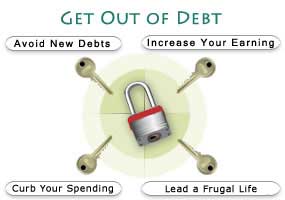
key to get out of debt
  1. Avoid new debts
  2. When you are already in debt, do not involve into more debts. This will increase your debt burden and lead you to more trouble. While you are already missing your regular payments yet taking newer debts, debt handling becomes a difficult task. Sometimes the situation can even go beyond control. It might be so critical that you end up declaring yourself as a bankrupt.

  3. Spend less
  4. Each penny counts; save every dollar. If you are seriously planning to pay off your pending debts, start to become frugal. But, do not change your way of life suddenly, it might create an adverse effect. Read as many frugal tips you can, and try to follow them effectively. Efficient budgeting can save you some bucks to reduce your debts faster.

  5. Increase your earning
  6. Earn more. If required, take up part time jobs or try other ways, for extra earning. Add itional inflow of money can help you to clear off your debts quickly, and become financially free.

  7. Extend your learning
  8. Finance, is the most important part in your day to day life. Try to know about it as much as you can. Researching on finance, reading good financial books and magazines will make you more experienced and well-versed in managing finances. This will help you to handle your pending debts proficiently.

You just need to get a good understanding of the 3 step formulae, and apply it effectively. This will help you to accumulate sufficient money to clear your pending debts. The process will be effective when you are determined and confident in following the three steps.

7 steps to become debt free

Living a debt free life is not unattainable though it is difficult and requires determination, time, patience and discipline. Given below is a run down of 7 steps that will assist you in the journey towards a life that is free of financial worries.

Step 1 - Admit that you are facing problems in managing your debts:
The first step towards debt free life is to come to terms with the fact that your debts have become unmanageable. Leaving bills unpaid and ignoring the problem does nothing to wipe off your existing debts; in fact it only worsens the situation. However, the fact that you're reading this article implies you have already accepted that you are in debt and you're ready to take the next step.

Step 2 - Assess your current financial condition:
Make a list of your debts. Next to the listed debts include the name of the creditor, the total amount you owe, the rate of interest you are being charged and the monthly payment you make towards this debt, if any. It will not only give you a clear picture of your financial standing but will also assist you in choosing an appropriate debt solution. Or else you can also take help from our Debt Income Ratio Calculator.

Step 3 - Prioritize your debts:
The next step is to decide which bills to pay first and which ones you can delay. It is suggested to concentrate on paying off the debts that carry a higher interest rate. You will save more money in the long run by ridding yourself off these expensive loans first, while keeping up the required repayments on the others. While making the repayment remember to pay a little more than the minimum as minimum debt repayments only covers the added interest; it makes no impact on the principal amount.

Step 4 - Create a feasible monthly budget for your expenses:
List all the essential expenses (like food, essential clothes, housing rent, electricity, gasoline, education fees, health expenses etc.) and the non essential expenditures (like spending on restaurants, movies, video games, parlors, gifts, snacks etc.). The non essential expenditures can be completely cut off or lowered substantially till you become debt-free. Even amidst the essential spending, you can look for options that will help you in saving without making any compromises.
Evaluate your monthly balance by subtracting monthly expenses from your monthly income. This will tell you how much money you have at the end of the month so that you can start paying off your debts. Do not forget to keep some money aside for unexpected expenses. As your debt load goes down, you will notice a fall in your interest costs.
A word of caution here: Remember to stay within your budget guidelines.

Step 5 - Say a big NO to any kind of new debt:
As you are in debt up to your eyeballs, adding on a new debt will increase your debt load and will hinder your journey towards a debt free life. You must decide once and for all that you will not add any new debt.

Step 6 - Talk to your creditors:
It is advisable to notify your creditors about the financial hassles you are facing in paying the bills. They may be willing to chalk out a repayment plan for you or renegotiate the loan terms and even temporarily suspend payments.

Step 7 - Seek professional help:
If you are not being able to manage your debts on your own, then you can opt for professional credit counseling. You will be guided by financial experts who will help you in taking a step closer towards debt free life by analyzing your financial status and then sorting out a realistic debt repayment plan for you.

Know how to solve debt problems

Are you in debt? Learn how to repair your bad credit and get out of debt quickly with the 5 major ways of solving debt problems. Given below are some of the widely availed financial options that help you to consolidate debt accounts.
Self Repayment Plan: You can reduce your debt burden on your own. Just by assessing your financial status, making an effective plan in clearing your pending debts and executing it successfully you can become debt free. Self repayment plans do not include third party fees but you need to have sound knowledge of different procedures to reduce debt load.
Debt Consolidation Loans: A type of personal loan, with which you can pay your unpaid debts like credit card bills, medical bills and other loans. The loan allows you in making a single payment on your multiple debts, dealing with a single creditor and reducing the outstanding balance. To know more about the debt consolidation loan, check out if you're the right candidate to apply for the loan, the inquiries you need to make before opting for it and the steps you should follow while applying for it.
Debt management program: DMP is a process to handle your debts. This is a method by which a credit counseling agency or a law firm provides debt assistance to manage your debts by reducing the APR. While opting for a debt management plan you should know the right time to opt for it, the process it follows, the advantages and the disadvantages of the debt management plan.
Debt Settlement: It is a process to eliminate your outstanding payments for less than the amount actually owed to your creditors. The process not only stops you from paying the monthly installments to your creditors, but also reduces your debts by 40% - 60% of the total amount. You can start a debt settlement program in two ways, by directly dealing with your creditors or by contacting a debt settlement company. The debt settlement companies usually deal with the creditors on your behalf. Apart from analyzing the advantages and the disadvantages of debt settlement, do not forget to choose the right time to settle your debts.
Bankruptcy: Bankruptcy is a legal proceeding which helps businesses and individuals to either repay or eliminate their debts. Bankruptcy is filed when the financial health of a person is not stable and he declares his inability to pay his debts. Bankruptcy is of 3 types- In case of Chapter 7; debt is recovered in exchange of property/assets belonging to the debtor. In Chapter 13, known as "reorganization", the debtor proposes a repayment plan and Chapter 11 is not widely applied for. Bankruptcy saves a person from facing any further legal action but it does not exempt him from paying back all of the debts.

10 Simple Steps to Manage Your Credit

By far the greatest invention the banks have ever come up with came out in the 20th century. Also the new field of Credit Management was born with the invention of the credit card. It is the most available out of any financial product out there. In fact more than 80% of the U.S. households have at least one credit card. If you want to consider yourself as the "Average" American then you have about 8 credit cards burning a hole in your wallet right now. To make sure that you don't get yourself in any trouble (again) try and follow these 10 Simple Steps for Credit Management. 1. Ignore the bank's/lender's rule on what is an "acceptable" level of debt. Your debt-to-income ratio, as they like to call it, is how much debt you can carry to the amount of money you bring make. Depending on how well you have managed your credit in the past it can fluctuate quite a bit. The average is about 25%. The ideal number is of course ZERO but for starters work on getting it down to 10-15%. 2. Remember what a credit card is...A Credit Card. Just because they have waved their magic wand and sent you your "Pre-Approved" Card doesn't mean go out and use it. The bank does not know your situation or your lifestyle all they look at is the number that you should be able to pay off using most of your "extra" money. They will keep you paying them for the rest of your life if you let them. Which brings me to the next point... 3. Don't pay just the minimum balances, unless of course you like paying 400% or more in interest. A typical Credit Card debt of $4,500 would take you about 44 YEARS to pay off! And you would end up paying about $17,000 total by the time you are done. When you stop and think about it, does that sound like a good deal to you' 4. Play the Game- Remember that you are the customer and "the customer" is always right. When it come to annual fees and higher interest rates ask for a lower rate. And if you slipped up and got a late fee ask to get it waived (make sure you promise never to do it again...well at least for six month) Remember that it is a lot more cost effective for them to keep a customer happy than it is for them to go get another one. Your $29-$35 late fee does not come close to the money they will have to spend to get a new one of you. 5. While you are playing the game don't get blindsided by the fees. The banks have come up with some very creative ways to make money at your expense. They have the ones that everyone knows like over the limit fee, late fee, and extra card fee. However, they also have the less obvious fees like account transfer fee, and a fee for talking to a live person instead of a recording. Make sure you look at your statement and check out all the charges. Some of them may surprise you. 6. Know how you stack up- BILLIONS AND BILLIONS of dollars are charged annually to consumer on mark ups in interest rates. That's a lot of money when you look at your share. Your credit information is something you should look at and make sure it is accurate. About 25% of all credit reports have erroneous information contained in them. Make sure your information is accurate and keep an eye on it regularly. 7. Know you limits- When you know you will have a hard time paying even the minimum balance STOP charging. It may sound simple but for millions of Americans it is very hard to do. Of course the easy way Hind sight 20/20 don't get in the situation. 8. If you are one of those people that are disciplined enough to pay off your balance at the end of the month then make sure you are getting some bonus for being such a great user. Get the free stuff that you can use. Some extra Flying miles, free gifts, Cash back reward (my favorite). If you are going to use it might as well get something for your efforts. 9. Only have what you need- You Should have 2 cards, one for what you use regularly and pay off every month and the other for emergencies or business. When you start trying to take advantage of all the deals out there the only one who gets taken advantage of are you. Overkill on your credit cards are not necessary, but being really good at managing a couple of cards is. 10. The statistics are in and they are mind boggling. Bankruptcies are at record numbers and the consumer debt for the U.S. is over 1.7 Trillion dollars! Teach your kids now to not make the mistakes that you did. Financial Literacy is a must for the next generation as we are heading into a cashless society. It's harder to manage what you cannot see. Make sure they understand that the credit card is what pays for food on the table and gas in the car as well as the play station games they love.

Debt stress causing health problems, poll finds

Economic woes a pain in the neck, back and more for millions of Americans

updated 12:22 p.m. ET June 9, 2008
function UpdateTimeStamp(pdt) {
var n = document.getElementById("udtD");
if(pdt != '' && n && window.DateTime) {
var dt = new DateTime();
pdt = dt.T2D(pdt);
if(dt.GetTZ(pdt)) {n.innerHTML = dt.D2S(pdt,((''.toLowerCase()=='false')?false:true));}
}
}
UpdateTimeStamp('633486253317070000');

WASHINGTON - The stress from deepening debt is becoming a major pain in the neck — and the back and the head and the stomach — for millions of Americans.
When people are dealing with mountains of debt, they're much more likely to report health problems, too, according to an Associated Press-AOL Health poll. And not just little stuff; this means ulcers, severe depression, even heart attacks.
Take Edward Driscoll, 38, of Braintree, Mass. He blames debt — $10,000 worth — for contributing to his ulcers and his wife Kimberly's panic attacks. "Just worrying, worrying, worrying, you know, where the next payment of this is going to come from,'' he says.Although most people appear to be managing their debts all right, perhaps 10 million to 16 million are "suffering terribly due to their debts, and their health is likely to be negatively impacted,'' says Paul J. Lavrakas, a research psychologist and AP consultant who analyzed the results of the survey. Those are people who reported high levels of debt stress and suffered from at least three stress-related illnesses, he says.
That finding is supported by medical research that has linked chronic stress to a wide range of ailments.
And the current tough economic times and rising costs of living seem to be leading to increasing debt stress, 14 percent higher this year than in 2004, according to an index tied to the AP-AOL survey.
Among the people reporting high debt stress in the new poll:
27 percent had ulcers or digestive tract problems, compared with 8 percent of those with low levels of debt stress.
44 percent had migraines or other headaches, compared with 15 percent.
29 percent suffered severe anxiety, compared with 4 percent.
23 percent had severe depression, compared with 4 percent.
6 percent reported heart attacks, double the rate for those with low debt stress.
More than half, 51 percent, had muscle tension, including pain in the lower back. That compared with 31 percent of those with low levels of debt stress.
People who reported high stress also were much more likely to have trouble concentrating and sleeping and were more prone to getting upset for no good reason.
When their construction business went under four years ago, Pamela Crouch, 61, and her husband, who had retired from General Motors, found themselves struggling under IOUs totaling $30,000.
"We just kind of felt desperate. We just really didn't have enough to live on to pay what we had to pay,'' recalls Crouch of Eaton, Ind. She remembers having trouble sleeping and concentrating. "We ended up paying a lot of our bills just on the credit card,'' says Crouch, a medical assistant in a nursing home. "We were stressed and depressed. ... It was really rough.''
Their son, a manager of a construction supply company, recently helped them out with their debt problems. "Things are doing much better,'' she says. "It made a world of difference in how we feel.''
'Fight-or-flight'It isn't known for certain whether such stress is causing health problems, says Lavrakas, who while at Ohio State University in the late 1990s helped to develop an index to measure the extent to which people are stressed from financial debts.

Debt collectors getting more aggressive

BBB reports a 20 percent jump in complaints from hassled consumers

By Herb Weisbaum
MSNBC
updated 9:00 a.m. ET Aug. 14, 2008
function UpdateTimeStamp(pdt) {
var n = document.getElementById("udtD");
if(pdt != '' && n && window.DateTime) {
var dt = new DateTime();
pdt = dt.T2D(pdt);
if(dt.GetTZ(pdt)) {n.innerHTML = dt.D2S(pdt,((''.toLowerCase()=='false')?false:true));}
}
}
UpdateTimeStamp('633543156265570000');

getCSS("3027626")
Herb Weisbaum
Profile

document.write('')
E-mail
document.write('
');

Mariko Mudd knew the collectors would keep calling. They wanted her to pay off that $4,000 credit card debt she owed. But the 25-year-old who lives near Seattle was out of work and couldn’t agree to a repayment plan. “I didn’t have any money,” she says.
One day the caller crossed the line from aggressive to threatening. He told her that if she didn’t pay by the end of the day, he’d have her arrested and thrown in jail.
“How can you throw me in jail?” she asked him. “How am I supposed to pay off my debt if you throw me in jail?” He told her that’s the way the law worked.Mudd was shocked and confused. She started to cry. Then she panicked. Afraid the police were on their way, she left the house. The debt collector kept calling and finally reached her father, convincing him to pay the $4,000 to keep his daughter from being arrested.
What happened here was illegal. “A debt collector may not make any false statements in the collection of a debt,” says Karen Hickey, an attorney for the Federal Trade Commission. “They cannot threaten arrest or imprisonment if the consumer does not pay the debt.”
Last year, the FTC received more than 70,000 complaints about debt collection agencies, the most complaints of any industry regulated by the commission.
The Better Business Bureau is also flooded with complaints. In 2007, more than 18,000 people complained about debt collectors, a 20 percent increase from the year before.
Not only are the complaints up, but more people report overly aggressive collection techniques. “They will call the person names, say you’re lazy or a horrible person,” says the BBB’s Alison Preszler. “People tell us, ‘I do owe the debt, but I shouldn’t be treated this way and called names.’”
getCSS("3053751")
Hounded by calls?
A collector may contact you in person, by mail, telephone, telegram, or fax. However, a debt collector may not contact you at inconvenient times or places, such as before 8 a.m. or after 9 p.m., unless you agree. A debt collector may not contact you at work if the collector knows that your employer disapproves of such contacts.
Some people complain they don’t owe the debt or that the collector is asking for the incorrect amount. Others complain about unfair or deceptive practices. For instance, some collectors falsely claim to be with a law firm.
Karen Hickey says the FTC is hearing about some “pretty serious strong-arm tactics.” These harassment techniques include profane language, telling a third party about the debt and threats of “dire consequences” such as property seizure, wage garnishment or loss of employment, if the person does not agree to the repayment plan. All of these actions are illegal.
Why are you calling me? Josephine Blake of Terre Haute, Ind., couldn’t understand why her phone kept ringing all day long. The automated message from a collection agency said, “It is imperative that you call immediately.”
Blake knew she didn’t have a past due account, but the calls would not stop. After three weeks of constant interruptions she decided to call back.
She says the agent never asked for her name, just her phone number. “I barely got the last three digits out of my mouth and she said, ‘it was a mistake and it’s already been taken care of.’” Blake tells me she still doesn’t know what was going on here.